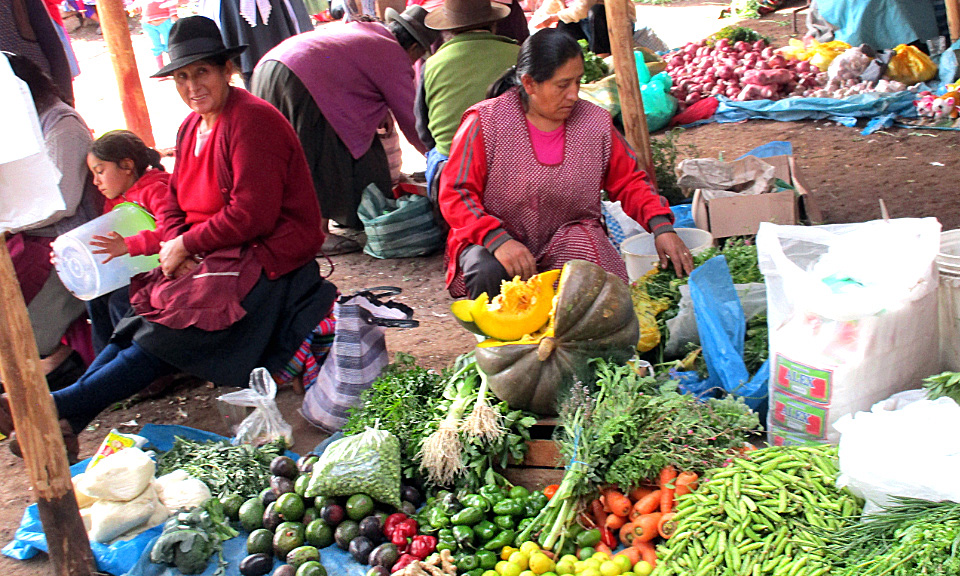

Peruvian Plant Medicine
This project began in 2019 when I visited Perú to document traditional plant medicine in the San Pedro de Cachora District, one of the nine districts of the province Abancay, located in south-central Perú.
In 2018, I had met Peruvian cultural anthropologist, Dr. Theo Paredes, when he was traveling in the United States while he was doing healing sessions. I had shown him a copy of my book of which I am the primary author: Bush Medicine of the Bahamas. He remarked that it would be important to undertake a similar project in Perú to preserve the indigenous knowledge of the practice of plant medicine.
So, Theo and I arranged a trip Perú. In December 2019, I met Theo in Cusco, and we drove about 3-1/2 hours west over many winding mountainous roads to the town of Cachora. There I was introduced to Ms. Marieta Romero Alvarez, a practitioner of herbal and traditional medicine, who in her bilingual capacity (Spanish and Quechua), was able to serve as data collector and translator for this research. What I hadn't anticipated was that Marieta spoke no English. Fortunately, my level of Spanish was mainly adequate to discuss the project, though I was assisted sometimes by Theo who is fluent in Spanish, Quechua, and English.
An unforeseen consequence of this research was that many of the interviewees spoke Quechua, not Spanish. Mainly for that reason Marieta did the interviewing herself. Unlike me, who had extensive training and experience in oral history research, I was not able to do the interviewing myself. I could only to provide some guidelines to Marieta as to the types of questions to be asked. Thus, the resulting breadth and depth of the research was not what I expected.
A couple of the interviews were conducted in noisy town settings, one in the midst of bells ringing at a church funeral across the road. On the other hand, had I been able to conduct the interviews myself, I am not sure of what the results might have been because I was an outsider from a very different culture. There were many questions that I would have asked that weren't asked, but that was the best that could be done. That said, after Marieta with assistance from Theo had interviewed 16 interviewees, we had documented 228 medicinal plants and 32 non-plant substances used in traditional medicine. That was much more than I expected. I appreciated that the interviewees were very warm, open, and generous in their responses.
Marieta kept extensive hand-written notes during the interviews while I made audio recordings. After the interviews, Marieta would go over her interview notes with Theo, speaking in Quechua and/or Spanish. Then, Theo would simultaneously translate those interview notes into English. So, as a result I had recordings in three different languages.
After returning to the States, I developed a huge database with the aim of documenting the scientific names from the Quechua (and Spanish) names. Once I had the scientific names I could search for the pharmacological actions of those plants. This turned out to be a very challenging task. There are about 45 dialects of Quechua of which there are two main types, and these include subgroups. Quechua is more accurately described as a family of languages, some dialects of which are mutually unintelligible. The greatest diversity occurs in Central Quechua (as spoken in Cusco) I discovered in my research, the Quechua name for one plant would have another Quechua name across several mile distances of south-central Perú.
On returning home, I downloaded several hundred English and Spanish documents that included journals, web resources, books, and Quechua dictionaries, I then used a software program called DocFetcher. Using that program I was able to search through several hundred documents using Quechua, Spanish or English words that refered to medicinal plants or substances. In this manner I could often quickly find the scientific equivalent of the search name. I assembled that huge amount of data into a spreadsheet that can be accessed on this website. Later on it will be incorporated into an e-book.
The common plant names in Spanish and Quechua derive from local folk taxonomy, a social-based classification system based on regional and cultural traditions rather than scientific principles. As mentioned in my book Bush Medicine of the Bahamas, folk taxonomy is "non-hierarchical: their classification scheme can best be described as a 'complex web of resemblances' that may incorporate elements of their cosmology".